Beyond Gaming: How AR and VR Are Transforming the Way Businesses Train, Learn and Operate

Category: AR/VR, Technology, Innovation
Introduction: A New Dimension of Business
For decades, businesses have relied on physical environments, classroom training and traditional digital interfaces to educate employees, demonstrate products and manage complex operations.
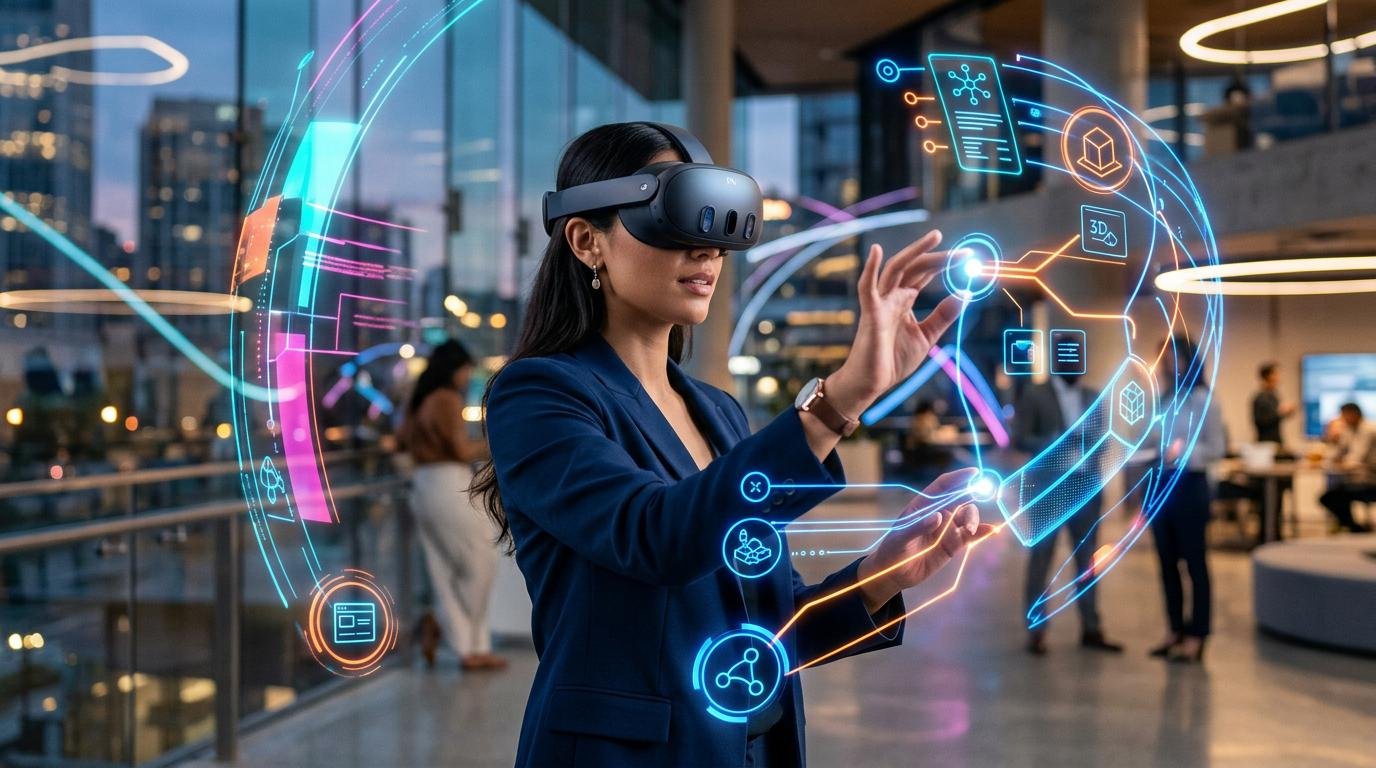
Today, Augmented Reality (AR) and Virtual Reality (VR) are changing these possibilities.
From immersive employee training to virtual product demonstrations, these technologies allow organizations to interact with digital environments in ways that were previously difficult, expensive or impossible.
What was once primarily associated with video games and entertainment is increasingly becoming a powerful tool for businesses across multiple industries.
At Fayzak Technologies, we see immersive technology as an important part of the next generation of digital experiences.
1. Understanding AR, VR and Mixed Reality
Although these technologies are often discussed together, each offers a different experience.
Augmented Reality (AR)
AR overlays digital information onto the physical world. Through smartphones, tablets or smart glasses, users can interact with virtual objects while remaining aware of their surroundings.
Examples include:
- Interactive product visualizations.
- AR-based interior design.
- Maintenance instructions displayed over machinery.
- Location-based interactive experiences.
Virtual Reality (VR)
VR creates an entirely digital environment that users can explore through immersive headsets.
Applications include:
- Virtual training simulations.
- Immersive gaming experiences.
- Virtual classrooms.
- Architectural walkthroughs.
- Industrial safety simulations.
Mixed Reality (MR)
Mixed Reality combines physical and digital environments, allowing virtual objects to interact with real-world surroundings.
It opens new opportunities for collaborative design, engineering and advanced visualization.
2. How AR and VR Are Transforming Employee Training
Traditional training methods often require physical equipment, dedicated facilities and experienced instructors.
Some training environments are also too dangerous or expensive to recreate repeatedly.
VR offers an alternative.
Organizations can create realistic simulations where employees practise tasks in controlled virtual environments.
For example:
- Industrial workers can practise equipment operations.
- Healthcare professionals can explore simulated clinical scenarios.
- Aviation personnel can experience training simulations.
- Construction teams can understand site conditions and safety procedures.
- Emergency response teams can rehearse critical situations.
Employees can repeat scenarios, learn from mistakes and build familiarity before entering real-world working environments.
3. The Real Estate Industry Is Entering the Immersive Era
One of the most promising applications of AR and VR is property visualization.
Traditionally, customers need to visit physical properties to understand layouts, dimensions and interior spaces.
Immersive technology changes that experience.
Potential applications include:
Virtual property tours: Customers can explore properties remotely using VR.
Interactive interior design: Buyers can visualize furniture, materials and design configurations through AR.
Architectural visualization: Developers can demonstrate proposed buildings before construction is completed.
Virtual showrooms: Real estate companies can showcase multiple developments through immersive digital environments.
These applications can make property discovery more interactive and improve how customers evaluate spaces.
4. AR and VR Are Redefining Education
Education is another sector where immersive technology can create meaningful opportunities.
Imagine students exploring the human body in three dimensions, travelling through historical environments or examining complex scientific concepts through interactive simulations.
Instead of relying entirely on textbooks and conventional presentations, learners can experience concepts visually and interactively.
Potential applications include:
- Virtual science laboratories.
- Interactive history lessons.
- Three-dimensional engineering demonstrations.
- Medical education simulations.
- Virtual technical training environments.
Immersive learning can support engagement and practical understanding when combined with effective instructional design.
5. Immersive Technology in Retail and Entertainment
Retail businesses are exploring AR experiences that allow customers to visualize products before purchasing.
Examples include virtual furniture placement, interactive product demonstrations and virtual try-on experiences.
In entertainment, AR and VR can create new forms of storytelling, interactive attractions and location-based experiences.
Gaming continues to be an important driver of innovation, with developers experimenting with immersive environments, spatial interaction and more natural user experiences.
The opportunity extends beyond traditional gaming into interactive brand experiences and digital entertainment.
6. The Technology Behind Immersive Experiences
Developing effective AR and VR applications requires more than creating visually attractive environments.
It involves integrating multiple technologies.
Some important components include:
- Game engines: Unity and Unreal Engine for real-time 3D environments.
- 3D modelling: Creating realistic objects, environments and characters.
- Spatial tracking: Understanding the position and movement of users.
- Computer vision: Enabling digital systems to interpret physical environments.
- Interaction design: Making virtual experiences intuitive and accessible.
- AI integration: Supporting intelligent virtual characters, contextual interactions and adaptive experiences.
The right combination depends on the intended application, target devices and user requirements.
7. Challenges Businesses Should Consider
Despite their potential, AR and VR implementations require careful planning.
Hardware accessibility: Not every customer or employee owns an immersive headset.
Development investment: High-quality 3D environments and interactive applications require specialized development resources.
User experience: Poorly designed interfaces can make immersive experiences uncomfortable or difficult to use.
Performance: Applications must be optimized for their intended devices.
Business value: Organizations should identify clear objectives before investing in immersive technology.
The best solutions are not necessarily the most technologically complex. They are the ones that solve genuine problems.
8. What Does the Future Hold?
The future of immersive technology is moving towards more connected and intelligent digital experiences.
We can expect continued innovation in:
- Lightweight AR glasses.
- More realistic VR environments.
- Spatial computing interfaces.
- AI-powered virtual assistants.
- Collaborative virtual workspaces.
- Real-time 3D visualization.
- Interactive digital twins.
As hardware and development tools evolve, immersive experiences may become increasingly accessible to businesses and consumers.
Conclusion: The Future Is More Than a Screen
AR and VR are changing how people experience information, interact with products and understand complex environments.
From gaming and entertainment to education, real estate and industrial training, immersive technology offers new ways to connect digital experiences with real-world applications.
For businesses, the opportunity is not simply to adopt the latest technology. It is to identify where immersive experiences can create measurable value.
At Fayzak Technologies, we believe the future of digital innovation lies in creating experiences that are interactive, engaging and meaningful.
The next evolution of technology will not just be something people look at. It will be something they can step into and experience.
Ready to Explore Immersive Technology?
Have an idea for an AR application, VR simulation, interactive game or immersive digital experience?
Connect with Fayzak Technologies and explore what’s possible.
Visit Fayzak Technologies to learn more about our technology and development capabilities.